


The Faux Kool Aid Of Post Racial America
By Solomon Sogunru
 In a recent conversation that took place at my work amongst my African American male coworkers, we were baffled to know that there wasn’t one black man in a senior position. Despite having a black president, this single example exemplifies how covert, sophisticated and subtle forms of racism manifest at some of America’s institutions against black males even in 2013. This theme counters the narrative of a “post racial” America that many blindly embrace.
America’s progress towards racial inclusion—a colorblind society—appears to be a dream deferred. Media images of multiracial families and friends interacting, amusing themselves within intimate settings, depict the perfect communal portrait. These images create the perception of a less racist and mistrustful society when, in fact, evidence-based research on any number of social issues reveals a different trajectory of America’s most disenfranchised communities.
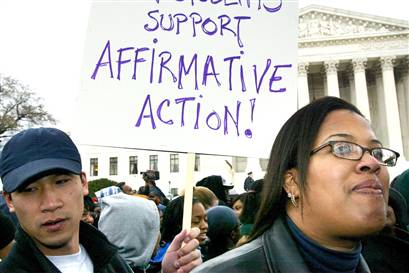
The pinnacle of this elusive and imagined colorblind society was further reinforced in the minds of the adherents to post-raciality through the historical election of our nations first black President, Barack Hussein Obama. With the highest office in the land being occupied by an African American, as well as a few other blacks in visible positions of authority in our country, the impression that our nation miraculously transformed into a “colorblind” society becomes ever more deceiving and simultaneously problematic. The portrayal of racial progress or acceptance across racial lines has led many to question the need for affirmative action in employment and college admissions. There has even been a few cases in which white persons have filed lawsuits alleging their fourteenth amendment rights had been violated, such as the recent Fisher case before the Supreme Court.
For African American males, the numbers of disenfranchised, unemployed and criminalized are mounting rapidly, revealing the impact of institutionalized American racism. A study conducted by the Center for American Progress identified that the “unemployment rate among black men was a staggering 18.3 percent over that same period while the unemployment rate among white men was 8.3 percent” during the second quarter of 2011, irrespective of educational attainment. Furthermore, during the “tight labor market of the late 1990’s, unemployment rates for black men remained twice that for whites” (Devah, Bonikowski, and Western 2009:777). This poses an ethical issue within institutions, since America is supposed to embody principles of equality.
The pernicious belief that America has arrived at a post-racial society and is now a colorblind nation betrays what black men all over this country face daily, their bleak future and the possibility of their destruction in a racist society unable to reconcile its history. Americans need to stop drinking from the bottle of a post-racial society, especially when black males are disproportionately affected by unemployment hiring and wage discrimination in comparison to white males in the workplace. Although some may find my claims to diminish the great progress and opportunities granted to Blacks in America, it will only spark further discussions on who is entitled or merit worthy in America. Moreover, the racial realism depicted in the aforementioned studies serves as microcosms as to why critical thinkers are needed to continue the dialogue on race and ethnicity issues so that we can enable society to transcend the limitations and frustrations of racism. Professor Audrey Thompson sums it best, “Insofar as white standards of beauty or intelligence rely on an implicit dichotomy or opposition between white purity, say, and black primitivism, they create a hierarchy that cultural pluralism cannot overcome.”

I would not argue with you. It is a dream to think that racism is over just because a minority is in the White House. I think that we are in the best time of American History for Race relations, but there is still generations of progress to go before we reach a level where race really does not play some part in American life. As long as we identify by race, race will be important.
Hi Darron. This is a case where much of what you say I agree with. Dialogue is one of the most valuable traits of a civil society because this is really the only way to come to a better understanding of one another, as people as well as groups. Whether sexual minorities such as gays and lesbians, racial minorities, women, etc., I feel that although U.S. society as well as all of the soceties like here in Germany benefit the most from dialogue. This is how we come to know one another and to understand one another. Sure, as men of color we have tremendous social complexities that we have to navigate - I like your website because you do such a great job describing some important social realities we must all deal with as minorities. What I like about living in Germany is that German civil society is very open to dialogue; in that sense it is very much like U.S. society. This is something that many people do not understand about modern Germany. I wish that I could personally make the social situation of men of color as a group in the U.S. better, however.
I would like to see a quantitative study on these post racial sentiments. Myself and others I know considered the election of President Obama progress but was under no illusion that racism had ended. In fact, we predicted the worst of racism to emerge based on the ugliness Jesse Jackson endured. Also, Obama being half white makes him appear to many white folk as ‘alright’ and less threatening. Nevertheless, as we are seeing, one drop of Black blood makes you Black. Eugenics, white supremacy, and social evolution are very much alive. The Bell Curve is still the bible for white intellectual bigots and pseudo scholars.